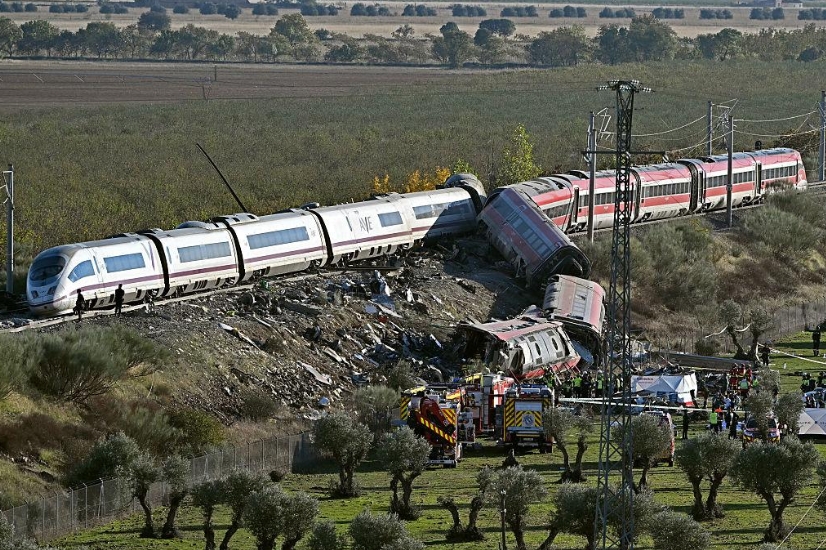
Spain is facing renewed questions about railway safety after a deadly collision involving two high-speed trains near the town of Urda in central Spain.
The accident occurred on Wednesday, October 28, 2026, when a moving train crashed into the back of a stationary train.
At least 68 people were reported dead, while approximately 80 others sustained injuries.
Emergency services rushed to the scene to rescue passengers trapped inside the damaged carriages.
The disaster is particularly concerning because it represents Spain's second deadly high-speed rail accident in less than a year.
How Did the Train Collision Happen?
According to preliminary information, the moving train was operated by Renfe, Spain's state-owned railway company.
The collision occurred after a railway signalling system failure.
Investigators are examining an order reportedly issued by a railway control centre that allowed one of the trains to resume normal speed following the signalling problem.
Authorities have described the circumstances surrounding the order as inexplicable.
However, the investigation is ongoing, and the final technical cause of the collision has not yet been established.
Investigators are expected to examine communication records, signalling equipment, railway control procedures and the sequence of events leading to the crash.
Emergency Teams Race to Rescue Survivors
The scale of the collision required a major emergency response.
Rescue workers used heavy machinery to access damaged carriages and search for passengers who might have been trapped.
Injured passengers were transported to hospitals in Madrid and surrounding areas.
Some survivors reportedly suffered serious injuries, including head wounds and other trauma.
Temporary medical facilities were also established near the accident site to assess passengers and provide immediate treatment.
The operation continued as emergency workers cleared the wreckage and searched for additional victims.
Spain's Railway Services Disrupted
The disaster caused significant disruption to railway services.
Authorities suspended high-speed train operations along the affected Madrid-Andalusia corridor while emergency and investigative operations continued.
Renfe also suspended ticket sales on the route until December 13, with alternative arrangements introduced for passengers travelling between Madrid and southern Spain.
The disruption has affected thousands of travellers who depend on the high-speed railway network.
Why Is This Spain's Second Deadly Train Disaster?
The latest collision follows another major railway accident near Adamuz in Córdoba province on January 18, 2026.
That earlier accident involved high-speed trains operated by Renfe and Iryo and resulted in 46 deaths.
The two accidents have intensified public discussion about railway safety and infrastructure maintenance.
Spanish authorities are facing questions about whether existing railway systems are sufficiently equipped to prevent similar disasters.
However, officials have cautioned against assuming that the two accidents share the same cause.
Will Spain Change Its Railway Safety System?
The latest tragedy could lead to further scrutiny of railway signalling technology and operational procedures.
One issue attracting attention is the use of the LZB signalling system on the Madrid-Seville high-speed route.
The system dates back to the railway line's opening in 1992, and the government has been considering modernisation.
Investigators will need to determine whether the existing technology, human decisions or a combination of factors contributed to the accident.
Any changes to railway safety procedures will depend on the findings of the official investigation.
What Happens Next?
Spain's immediate priority is supporting the victims, treating injured passengers and providing assistance to affected families.
Investigators will continue examining the circumstances surrounding the collision.
The disaster has also renewed the national debate about railway infrastructure, safety standards and the responsibilities of transport authorities.
For many Spaniards, the most important question is how such a tragedy can be prevented from happening again.