# SEO Title Lindsay Clancy Returns to Court as Judge Considers Whether Murder Charges Should Be Dismissed
# Meta Description Lindsay Clancy appeared in a Massachusetts court on November 2 as her lawyers challenged a possible retrial over the deaths of her three children. The judge scheduled another hearing for November 16.
# Excerpt Lindsay Clancy has returned to court as her lawyers attempt to prevent a second murder trial over the deaths of her three children in 2023. The judge has not yet ruled on the defence's arguments, leaving the possibility of a retrial unresolved.
Lindsay Clancy Returns to Court as Murder Retrial Remains Uncertain
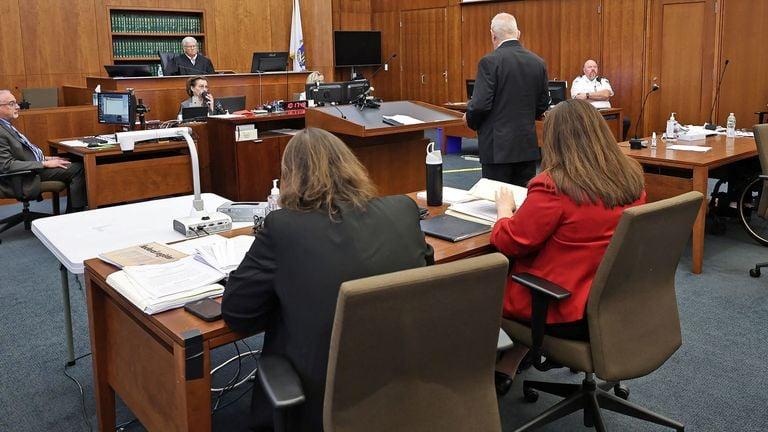
Lindsay Clancy appeared in a Massachusetts courtroom on Monday, November 2, 2026, as her legal team continued efforts to have the murder charges against her dismissed following a mistrial in her first trial.
The hearing focused on whether prosecutors can legally retry Clancy over the deaths of her three young children, who died at the family's home in Duxbury, Massachusetts, in January 2023.
Her defence lawyers argued that holding another trial would violate her constitutional protection against double jeopardy, which generally prevents someone from being prosecuted twice for the same offence.
Prosecutors opposed the request, arguing that the first trial ended without a verdict because the jury could not reach a unanimous decision.
Judge William Sullivan did not issue a final ruling on Monday. Instead, he took the arguments under consideration and scheduled another hearing for November 16.
The case has attracted widespread attention in the United States because of the circumstances surrounding the children's deaths and the disagreement over Clancy's mental state at the time.
Why Lindsay Clancy's First Trial Ended in a Mistrial
---------------
Clancy's first trial ended in September 2026 after jurors failed to reach a unanimous verdict.
She faced three first-degree murder charges relating to the deaths of her children: Cora, five, Dawson, three, and Callan, eight months old.
The prosecution argued that Clancy deliberately killed the children at their home on January 24, 2023.
Her defence did not dispute that she caused their deaths. Instead, her lawyers argued that she was experiencing postpartum psychosis and should not be held criminally responsible because of her mental condition at the time.
After weeks of testimony and deliberations, the jury remained divided.
Reports indicated that 11 jurors favoured finding her not criminally responsible, while one juror disagreed. The disagreement prevented the jury from reaching the unanimous decision required for a verdict.
The judge subsequently declared a mistrial.
A mistrial means the trial ends without a final verdict. Depending on the circumstances and applicable law, prosecutors may be able to bring the case before another jury.
Defence Lawyers Challenge the Possibility of Another Trial
---------------
During Monday's hearing, Clancy's legal team argued that the judge should not have declared a mistrial without taking additional steps to address the disagreement among jurors.
The defence also raised concerns about the conduct and background of the juror who reportedly disagreed with the majority.
Her lawyers argued that the court should have investigated allegations that the juror may have used a mobile phone to research information during deliberations and may not have fully disclosed relevant background information during jury selection.
The defence believes these issues could have affected the fairness of the original proceedings.
The juror's lawyer has disputed the allegations, while prosecutors maintain that the judge handled the jury's disagreement appropriately.
The prosecution also argued that further questioning of the juror could improperly interfere with the privacy of jury deliberations.
Prosecutors Oppose Dismissal of the Charges
---------------
Prosecutors are asking the judge to reject the defence's request to dismiss the charges.
They argue that the first trial ended because the jury genuinely could not reach a unanimous verdict, making a retrial legally permissible.
According to reporting by The Washington Post, prosecutors indicated during Monday's hearing that a retrial was the likely course, although they had not made a definitive decision while the outstanding legal motions remained unresolved.
If the judge rejects the defence's request, prosecutors could proceed with another trial.
The charges could carry a mandatory sentence of life imprisonment without parole if Clancy is convicted of first-degree murder.
However, no final decision on the next trial has been announced.
Judge Schedules Another Hearing for November 16
---------------
Judge William Sullivan has scheduled November 16 as the next important date in the case.
The court is expected to continue considering the outstanding legal arguments, including the defence's request to dismiss the charges.
A retrial could potentially begin in March 2027 if the case proceeds, although that timetable is not yet final.
The judge's decision on the pending motions will determine how the case moves forward.
For now, Clancy remains in custody at Tewksbury Hospital while the legal proceedings continue.
The Case Has Renewed Discussion About Postpartum Mental Health
---------------
The case has also attracted attention because of the defence's argument that Clancy was suffering from postpartum psychosis when the children died.
Postpartum psychosis is a rare but serious mental health condition that can develop after childbirth. It can involve severe confusion, delusions and hallucinations and requires urgent medical attention.
Clancy's lawyers have argued that her condition affected her ability to understand and control her actions.
Prosecutors, however, have argued that she should still be held criminally responsible.
The disagreement places significant importance on the medical evidence presented during the original trial and any evidence that may be introduced in a second trial.
What Happens Next?
---------------
The November 2 hearing has not brought the case to a conclusion.
The judge must still decide whether the defence's double-jeopardy argument has sufficient legal grounds to prevent another prosecution.
If the charges are not dismissed, prosecutors may move forward with a retrial.