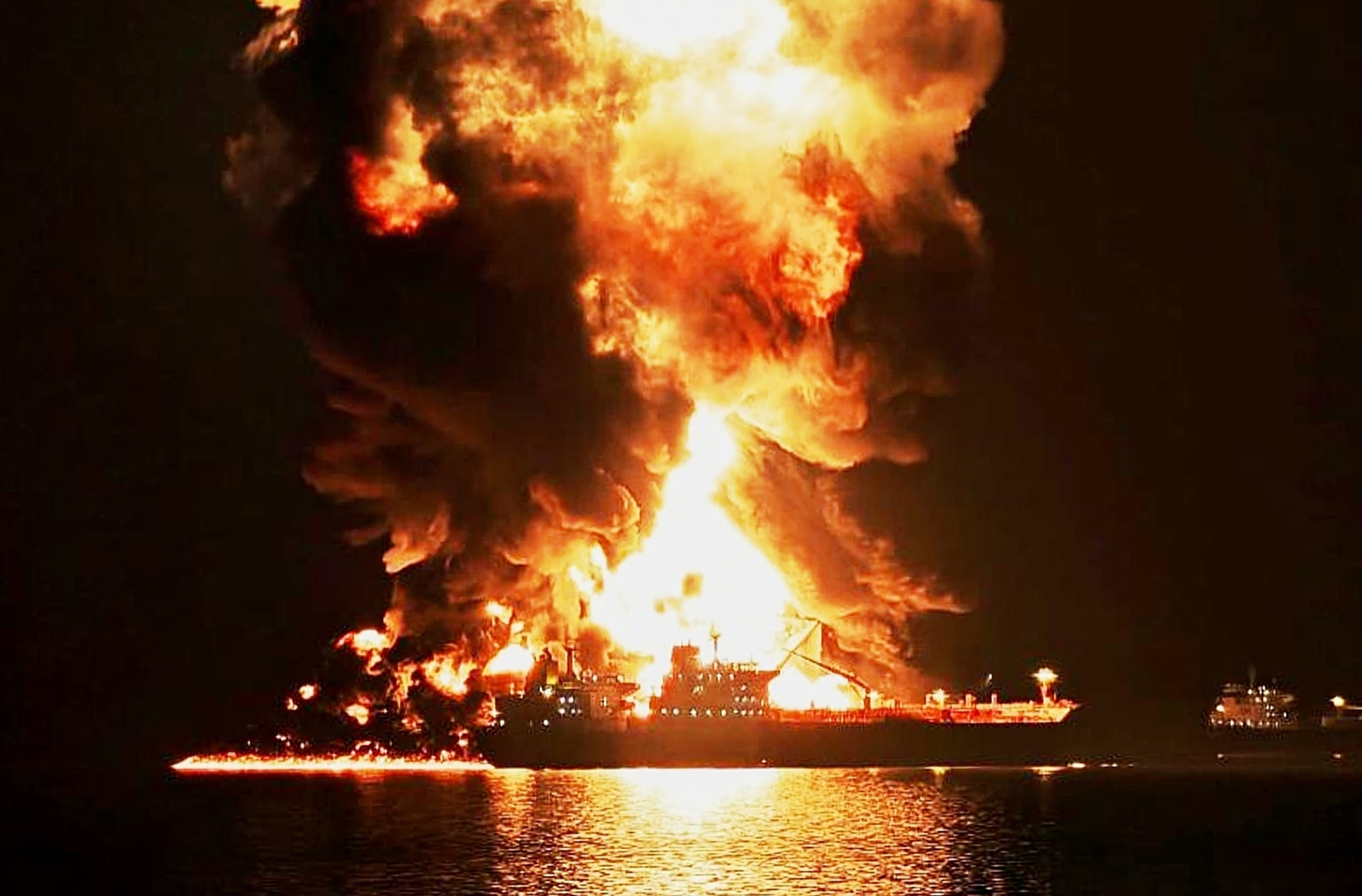
Iran Reports Two Tankers on Fire in Strait of Hormuz as Trump Signals Possible End to War
Iran has reported that two oil tankers caught fire after hitting naval mines in the strategically important Strait of Hormuz, raising fresh concerns about the safety of international shipping and the global energy market.
The announcement came as US President Donald Trump again suggested that the ongoing conflict involving the United States, Israel and Iran could come to an end soon.
According to reports carried by Iranian state media, Iran's Islamic Revolutionary Guard Corps (IRGC) Navy said the two tankers encountered mines while attempting to pass through a shipping route Tehran considers unauthorised.
The incidents reportedly left the vessels unable to continue their journeys.
However, the claims surrounding the latest tanker incidents have not been independently verified in full.
What Happened to the Oil Tankers?
---------------
Iran's Revolutionary Guard said the two oil tankers were travelling through a route it had warned vessels against using.
Tehran has repeatedly argued that ships must follow routes authorised by Iranian authorities, while the United States has promoted alternative shipping arrangements through the waterway.
The disagreement has created serious uncertainty for commercial shipping companies operating in the region.
A separate Reuters report published on November 1 also reported that Iran's IRGC Navy said two tankers had exploded after hitting mines while travelling through what it described as an unauthorised route.
The incidents come after other reports of vessels being struck or catching fire around the Strait of Hormuz.
It remains important to distinguish between Iran's claims and independently confirmed information about the incidents, including the precise identities of the vessels and the full extent of the damage.
Trump Says the War Could End Soon
---------------
US President Donald Trump has renewed his suggestion that the conflict with Iran could end soon.
In comments reported by Al Jazeera on November 2, Trump said the war would end "very soon, one way or the other", while warning that Iran would need to reach an agreement or face further action.
His remarks come amid continuing uncertainty over whether Washington and Tehran can reach a diplomatic settlement.
Iranian officials have also indicated that communication through regional mediators is continuing.
However, the two countries have not announced a final agreement to end the conflict.
Iran and the United States Continue Diplomatic Discussions
---------------
Despite the military tensions, diplomatic efforts have not completely stopped.
Iran's Foreign Ministry said on Monday that communication with the United States was continuing through intermediaries.
Reuters reported that recent discussions involving Qatari mediators ended without a breakthrough, although both sides continued exchanging messages.
Iran has also presented conditions linked to reopening the Strait of Hormuz and restarting negotiations.
The United States has not publicly accepted all the conditions proposed by Tehran.
The situation leaves the possibility of further negotiations open, but there is still no confirmed agreement bringing the conflict to an end.
Why the Strait of Hormuz Matters to the World
---------------
The Strait of Hormuz is one of the most important shipping routes in the global energy industry.
It connects the Persian Gulf with the Gulf of Oman and the Arabian Sea, allowing major oil and gas exporters in the Middle East to transport energy supplies to international markets.
A significant share of the world's oil supply normally passes through this narrow waterway.
Any prolonged disruption could affect oil availability, shipping costs, insurance premiums and fuel prices across different countries.
For countries such as Nigeria, developments in the region could have consequences for international crude oil prices and domestic fuel costs.
Higher global oil prices can potentially increase government revenue for oil-exporting countries, but they can also create additional pressure on consumers when petroleum product prices rise.
Oil Markets React to Hopes of a Possible Agreement
---------------
Developments in the conflict have continued to influence international energy markets.
Reuters reported on November 2 that oil prices fell sharply as diplomatic efforts raised hopes that the conflict could eventually ease.
However, the possibility of further attacks on commercial vessels remains a major concern for shipping companies and energy traders.
If the Strait of Hormuz remains unsafe or restricted, the impact could extend beyond the Middle East and affect businesses and consumers worldwide.
What Happens Next?
---------------
The coming days could be important for determining whether diplomatic discussions make meaningful progress.
The key questions include whether the United States and Iran can agree on conditions for ending the conflict, whether shipping activity through the Strait of Hormuz can return to normal, and whether further attacks on commercial vessels can be avoided.
For now, Iran's latest tanker announcement and Trump's comments highlight the uncertainty surrounding the conflict.
Although both sides have left room for diplomacy, there is no confirmed peace agreement yet.